Showing posts with label 19th century. Show all posts

Thursday, 28 August 2014

Challenge #6 - Seasonal. Lamb chops with tomato sauce (1835)

For the 6th challenge, I wanted to try a recipe from a new (for me) cookbook, the 1835 "Handbok vid den nu brukliga finare matlagningen[...]" by Margareta Nylander which originally was published in 1828 (i.e. "Handbook for the presently common finer cooking").

As usual, scroll to the bottom of the page for a quick write-up!


In the preface the author claims that all recipes in the book are thoroughly tested to ensure suitability for the Swedish cook, especially the one working in a better kitchen. I thought that was interesting, because I found a recipe that included tomatoes, something I hadn't heard of this early in the 19th century in a Swedish context.

I asked a friend who is more versed in antique cookbooks, and she knew of one even earlier recipe from 1821. That cookbook, however, was obviously directly translated from French and may not have taken into account what was actually used and available in Sweden at the time.

According to the vendor, this variety (Costoluto Genovese) is common in Italy and has been around since the early 19th century. 
I had to try and research the history of the tomato in Sweden, and even to I couldn't reach a conclusive verdict, I found some clues.

First, the tomato wasn't called 'tomat' as we say presently in Sweden when it was first mentioned; it was called 'pomme d'amour' (love apple) - isn't that darling? Carl von Linné naturally knew of the tomato since he was the one that classified the plant, but he believed that the fruit was poisonous when grown in a Scandinavian climate because it couldn't fully ripen (which isn't true, of course) although he acknowledged that the tomato was successfully grown and healthy to eat in countries like Spain.

How long this assumption prolonged, I do not know. In 1811, a book on household matters by Nicolas Appert was translated into Swedish from French and describes when tomatoes should be harvested (I have only read a snippet from the book so there might have been more). Again, since this was a translation from French, the mere mentioning of tomatoes is not definite evidence of them being commonly eaten or available in Sweden at the time.
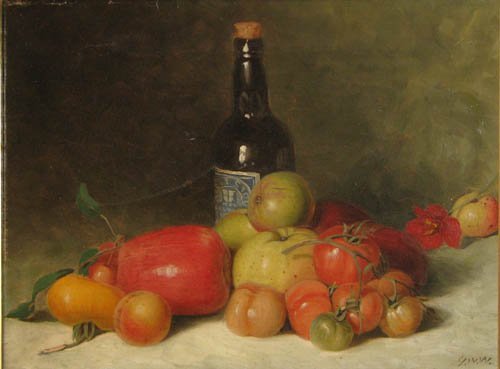
George William Whitaker, late 19th century?

Then I found a wonderful book on Google Books, a 1815 dictionary of commerce. It lists all sorts of things that could be produced, manufactured, grown, caught and eventually sold, both domestically and internationally, from lace to iron. The entry for 'love apples' is short and doesn't exactly tell us if the tomato was actually imported to Sweden but I still think it is interesting that it's mentioned. The entry describes the tomato as common in Spain and Italy, where it is used for soups as well as pickled with pepper, oil and salt and also eaten as a refreshing and cooling snack.

Then we have the 1821 cookbook I mentioned above, and finally the 1835 recipe I decided to make for the challenge. Up to that point it's still hard to say how common tomatoes were in Swedish kitchens, but thankfully it gets easier after that but I'm going to limit myself to mentioning that tomato jam was offered for sale in Stockholm in 1842 and in 1853 were plain tomatoes (this time called 'tomat') advertised in a Stockholm newspaper. And in Swedish-speaking Finland tomato seeds for gardening were available in 1852, so I think it's fair to say that by the mid-19th century, tomatoes may not have been common but certainly not unheard of.

Onward to the recipe (and i guess it's clear by now that I chose the tomato as my seasonal ingredient!):

Lamb chops with Pomme d'Amour Sauce


 It was a simple recipe: lamb chops with salt and pepper dipped in clarified butter and breadcrumbs...

...then fried.


The tomato sauce was equally non-complicated. Tomatoes were cut into wedges and put into a sauce pan with a piece of butter and some water to simmer until soft (well, the recipe didn't say as much, but it made the most sense to me).


The tomatoes were then strained through a sieve, thus.

Then I melted some butter with flour in a saucepan, added bouillon (the non-period cubed variety...) and lastly the tomato sauce. It simmered on until the thickness seemed acceptable and was served on a dish with the lamb chops as per instructions!

Ta-da!
The colours are a bit off in this picture (even though I tried to correct them in PS) but I can assure you that it looked much better in reality. The sauce wasn't tomato-red, but a softer orange shade, like Campbells tomato soup (I added the chopped parsley just for some additional colour).

And when all was said and done, the sauce actually did taste like a mild tomato soup. Since the recipe didn't call for any additional seasoning, except for the bouillon, it was not a huge sensational experience, but nice all the same (then again, Swedish commercial tomatoes are a bit bland even when they're at their best).

The lamb chops, well, they were lovely because you can't go wrong with lamb chops, in my opinion. The bread crumbs really added some yummy texture (and extra fat to be sure!).

So, considering how easy and comparatively cheap this recipe was, I'd absolutely say this was a success. My husband liked it as well and he's not always easy to please so that's something!


The Challenge: #6: Seasonal fruits and vegetables


The Recipe: Lamm-Kortletter med Pommes d'Amour-Sås (Lamb chops with tomato sauce) from Margareta Nylander's cookbook (online version courtesy of Umeå University Library).


The Date/Year and Region: Sweden, 1835.


How Did You Make It: I cooked tomatoes with butter and water until soft, then strained them through a sieve and added the juice to melted butter with flour and bouillon and cooked until thick. The lamb chops were seasoned with salt and pepper, then dipped in clarified butter and breadcrumbs and fried in butter.


Time to Complete: Less than 30 minutes.


Total Cost: The biggest cost were the lamb chops, since lamb is often expensive where I live, the rest was cheap or I had it on hand so let's say  about $11/8EURO for two persons (we were very hungry so i planned for 2 small lamb chops per person).


How Successful Was It?: The sauce was nice, if a little bland, probably because Swedish tomatoes tend to be a little bland! Some herbs, like basil, would have been a nice addition. The lamb chops were delicious with a breadcrumb coating.


How Accurate Is It?: Well, firstly, I how no idea how tomatoes tasted in 1835 so I used modern, normal commercial tomatoes. I also used store-bought breadcrumbs and modern store-bought bouillon cubes. So, not quite accurate after all.

Recipe source: 
  • Nylander, M. (1835). Handbok wid den nu brukliga finare matlagningen : innehållande tillika beskrifning på confecturer, sylter och glacer ; samt ett bihang, att göra soja, fransk senap, ättikor, bär-winer, bär-safter, att inlägga anjovis, m.m. ; jemte några underrättelser om slagt, brygd och brödbakning. (6. tillökta och förbättr. uppl.) Stockholm: Online version courtesy of Umeå University Library

Tuesday, 17 June 2014

Challenge #1 - Literary food. 'Meat pie', or Pastej af stek.


Literary Foods - Food is described in great detail in much of the literature of the past. Make a dish that has been mentioned in a work of literature, based on historical documentation about that food item.

For the short write-up, scroll directly to the bottom!


Carl Michael Bellman (1740-1792) is perhaps as close as we get to a national poet in Sweden. His songs and poems are still well-known and sung here and are to me (and many others) a magical portal into 18th century Stockholm, to the gutters, public houses, bed chambers, pastoral picnics and all the other places Mr Bellman panted with words. A treasure indeed.

Source: Wikimedia
I chose one of the many drinking songs that Bellman wrote as my inspiration for this challenge (Fredmans sång N:o 14: Hade jag sextusende daler/If six thousand dalers they gave me). This one is about all the things you could do if you, somehow, got hold of a lot of money. The persona in this song will buy a great house with tonnes of servants, hold magnificent parties, buy beautiful things, keep a beautiful mistress or two and gamble among other things - but more than anything else: drink, drink and drink!

In the second verse below, something called Nubben's kräftpastejer (crayfish pies) are mentioned. That was my starting point. But minus crayfish. So, pies.

||: Löpare och kusk och lakejer,
     som jag säjer,
skulle jag också ha,
mumsa Nubbens kräftpastejer,
     jag ej väjer :||
ropa natt och dag hurra.
Men framför allt så skulle jag dricka.
     och så nicka
     och så hicka
     och så dricka,
glömma världens små besvär.

(Martin Best recorded an English version of this song in the 1970s, but the verse with the pies is omitted from his version that is based on a translation by Paul Britten Austin. You can listen to the song on Spotify among other places).

 I'm going to be honest here! I force-fitted the following recipe into this challenge's theme. That is, I decided on the recipe first, and then tried to squeeze it into the theme. The key word here is pastej. In the Swedish language of today, pastej typically refer to a pâté-like dish. But back in the days, a pastej meant some kind of savoury filling inside a crust of dough baked in an oven - in other words: a pie. Funnily enough, the word pie is now used in the Swedish language (but spelled paj) and refers to both sweet and savoury pie dishes.

The reason for choosing a pastej/pie was that I was going on a historically themed picnic on June 6th and I wanted to try a recipe suitable for picnic food: not messy, easy to transport and edible without too many utensils. Small, Pirozhki-like pies seemed suitable.

And I did find a recipe that looked tasty and not too hard for an unskilled and sloppy cook:

Pastej af stek, or (approximately), little meat pies. 
This is a recipe from a Swedish 1821 edition of an cookbook originally published in 1804 by Carolina Weltzin (who by the way had several literary connections; she translated novels and plays, wrote travel literature besides several works on cooking and housekeeping. And not least, Carl Michael Bellman dedicated one of his most beloved songs to her).

The recipe called for any sort of left-over meat: beef, veal, lamb or hen.

A rough translation of the recipe:
When you have cold leftovers of meat, whether it is beef, veal, lamb, or hen, chop it fine, melt butter over the fire and add some flour, finely chopped onion, lemon peel and parsley, stir it together over the fire, and add the chopped meat, some wine, gravy, if you have, or stock, a couple of egg yolks, mace, salt and grated bread, and stir well over the fire, and let it cool. Then you take puff pastry, do not make it too thin, and put it into small mould; put some of the filling therein, and cover with a lid of puff pastry or strips of puff pastry laid out in a grid pattern and bake in the oven. You may also bake them without moulds if you take squares of pastry, put some of the filling thereupon and fold the rest of the pastry over and seal with some egg; thereafter they are baked in the oven.
Day 1. 
I didn't actually have any leftovers on hand, but I did have a small hen in the freezer so I decided to cook it and pretend I had. I wanted to prepare the hen in a somewhat period manner and looked in an older cookbook (Cajsa Warg; see sources below) and found a recipe for hen fricassee. I followed the directions for the first half of that recipe, which was to let the hen boil/simmer in water with crushed ginger, butter, lemon peel, a whole onion and parsley.
Not too complicated, and tasty!
I let the hen boil/simmer for nearly three hours - I had planned on ~2 but forgot about it! At least the meat wasn't chewy... I picked all the meat from the bones and put it in the fridge over night.

Day 2.
Most of the ingredients for the pie fillings can be seen below. I used some home-made chicken stock I had stashed away in the freezer instead of 'gravy' (because I had no idea what kind the recipe referred to) and white wine. I used store-bought bread crumbs as well, since bread rarely have the chance to go stale and dry in this household.

The cooking process was uninteresting and resulted in a not too good-looking mince-like filling:
But it was very tasty! A flavour of lemon was quite distinct and made it taste fresh and a bit tangy (I think the wine helped as well). I was very pleased so far. 

While the filling cooled off I made the dough and here I strayed away from the recipe. It did call for puff pastry, and the cookbook had a recipe for that, but I haven't made a proper puff pastry from a modern recipe ever, and I wasn't sure if I was going to be successful with a historical one (that also was quite different from modern recipes). I know that making a good puff pastry is labour intensive and takes many hours. I didn't have the time, the skills or the inclination, to be frank.

So I went to another early Swedish cookbook from 1802 (by Anna Maria Rückersköld; see sources below) and found a recipe for a dough that was recommended for pies. It looked a lot less complicated than a puff pastry, and the author added that it was a lot easier to digest than the former! So, yeah, that was totally the reason for using this recipe instead!


Approximate translation:
Take 1 mark (212,5 gram) flour and ½ mark unsalted butter and when it is well worked together make a hole therein and add three eggs and work them into the dough and splatter cold water thereupon, a little at a time, until the dough is rather hard, then it is worked until it is tough.
That didn't sound too bad, but I'm not sure how successful I was. Maybe the eggs were too large, but the dough was far too sticky as long as I followed the recipe. I had to add quite a bit of flour to make it resemble a functional pie dough, and I'm still not sure that I would call it tough but it seemed to work.

I let it rest in the fridge for appr. 30 minutes before I made the pies. I used the method mentioned that didn't call for moulds and took ca. 12X12 cm squares of rolled out dough, filled them up, folded over with some egg between the edges and sealed them up by pressing down with a fork. I forgot to take any pictures of this, but they pretty much looked the same before and after their time in the oven (I baked them for 10-15 minutes, I think).

I know that poor craftsmen blame their tools, but my oven is terrible at it's job. I love my gas-top stove but I hate the gas oven that's part of the deal. All heat comes from below which in reality means that everything baked in the oven will look unbaked on top, and slightly to very baked on the bottom-side.

So this is what I ended up with. No they don't look very appetizing. Unfortunately, I'm very used to that.

BUT - they tasted very good, much thanks to the filling (the dough was alright but nothing to write home about, a bit dry and bread-y). I ended up with 13 little pies that I brought to the picnic and treated friends and strangers to and they were well received in spite of their unfortunate appearance.


The Recipe: Pastej af stek/Meat pie from a 1821 edition of Carolina Weltzin's 1804 cookbook with the LONG title of: Ny kokbok. Eller Anwisning till en myckenhet nu brukliga mat-rätters tillredande; jemte ett bihang innehållande kunskaper om hwarjehanda hushålls-rön. Available in pdf version here.

The recipe for the dough is from an 1801 edition of Anna Maria Rückerschöld's Den nya och fullständiga kok-boken[...] available as pdf here.

I also took a peek in Cajsa Warg's 1755 cookbook that unfortunately isn't available online.

The Date/Year and Region: Sweden, early 1800s.


How Did You Make It: I made a pie dough of butter, flour and eggs and filled them with a mince of cold hen's meat, onion, parsley, eggs, wine, chicken stock and spices. They were made into small envelope-like pies and baked in the oven.


Time to Complete: If you count cooking the hen, five hours? otherwise, perhaps two hours.


Total Cost: I had most of the ingredients on hand, so not much; I consider this a rather cheap dish.


How Successful Was It?: They tasted so much better than they looked! I was very happy with them, and my husband who is a very picky eater also liked them, which I take as a very good review.

How Accurate Is It?: Not too bad, I think. I used store bought bread crumbs, but otherwise I think I used as good ingredients as I could considering this day and age. My gas oven isn't very period though. And it's a bad, bad oven.

At last, some bonus pictures from the picnic! It was a huge multi-era historical picnic held on the national day in Sweden.


Me. I chose clothes to match the food. Of course.

Guests with food.

Most of the guests posing for a group photo.


Minus the blue plastic bowl, this is a very pretty 'picnic-set'!
This as well.
Sources:


  • Rückerschöld, Anna Maria (1801). Den nya och fullständiga kok-boken, innehållande beskrifning, at med mindre kostnad tilreda hwarjehanda smakliga rätter äfwen af potates, samt wälmenta råd och påminnelser, som jämwäl för bättre hushåll kunna wara tjenande, jemte bihang af et litet hushålls-allahanda [Elektronisk resurs]. 2. upl. Stockholm: Available online as pdf.
  • Warg, Cajsa (1755). Hjelpreda i hushållningen för unga fruentimber./(C.W.) Stockholm, tryckt hos Lor. Ludv. Grefing, på desz egen bekostnad 1755.. Stockholm: page 189.

  • Weltzin, Carolin (1821). Ny kokbok. Eller Anwisning till en myckenhet nu brukliga mat-rätters tillredande; jemte ett bihang innehållande kunskaper om hwarjehanda hushålls-rön. Af C. Weltzin. Fjerde upplagan. Stockholm, 1821. Tryckt hos direct. Henrik A. Nordström, [Elektronisk resurs] : på eget förlag.. Stockholm: Available online as pdf.
A selection of Paul Britten Austins's English translations of Carl Michael Bellman's poems and songs can be read online here.

Tuesday, 3 June 2014

A brief introduction and a recipe tested and tried!

Hello, and welcome!

I have made this blog with the intention of documenting my participation in the Historical Food Fortnightly, which started just a couple of days ago. If you haven't heard about it - find out more here!

I'm a 30-something Swedish female with a life-long interest in history, especially cultural and social aspects of the 17th, 18th and 19th century. My interest in the history of fashion have fore some years manifested itself in historical costuming and I participate in reenactment groups in Sweden. I used to blog about my costuming here, but that blog is more or less defunct for now.

When I heard about the Historical Food Fortnightly, I was very thrilled. I have been curious about historical cooking (mainly 18th and 19th century) for a long time, but haven't really pursued that interest, but hopefully these upcoming challenges will spur me to explore and experiment with recipes, techniques and flavours of the past.

That said, I have to admit that I'm not a very good cook even by modern standards, so I don't expect to become a very accomplished historical cook by any means. I have close to zero practical experience when it comes to food history and my only tools for now is an average, modern kitchen, for better or worse.

But my main goals are to have fun, hopefully learn and amuse readers of this blog and other participants in the challenge, and I think that will do for a rather good start.

Anyway! The following recipe is not part of the challenge, but since I remembered to take some pictures, I thought I'd write a few words about it, so without much further ado, I give you:

TUNNRÅN

I guess you could translate this to "thin wafers" and that's exactly what it is. I don't have a date for this recipe, but I would wager late 18th century or early 19th century. It's from a scanned pdf version of a Swedish 1786 cookbook I've had for ages, but only last week I realised that there were lots of handwritten recipes in the very back of the book. How wonderful!

When, and by whom, these recipes were written we'll never know, but fortunately that's not necessary for trying them out.


This recipe had at least some exact measures (which was very appreciated by me, used to modern, exact recipes!) to help starting out, and they were:
  • 1 qvarter (ca 33,3 cl) cream
  • ½ stop (ca 6,5 dl) water
  • 1 egg
After that, intuition and common sense had to be employed! The recipe instructed to add sugar  "to taste", then flour until the mixture slightly stuck to the whisk. Lastly some cinnamon and cardamom. 


I really should have taken note of how much sugar and flour I used, but I completely lost track. I added the flour little by little until I thought the batter was not too runny, not too thick.The finished batter was something akin to pancake batter and slightly sweet but not overly so. I was generous with seasoning but I can't say how much I used.

This is the finished batter. It was. A. Lot. of batter.

Since I hadn't tried this recipe before, I had planned to make half a batch, but decided against it since half an egg seemed silly... Well, I regretted that a bit. Here's hoping it wasn't going to be a disaster...

The recipe didn't have any instructions at all in regard to how to use the batter, probably since it was a no-brainer to the cooks of the time, but the go to method was to use a wafer iron, perhaps like this one:
Wafer iron, undated. Vänersborgs Museum via Digitalt Museum.
Another kind wafer iron could look like this
Wafer iron, undated. Vänersborgs Museum via Digitalt Museum.
but from what I can gather, the first kind was used for tunnrån ("thin wafers") and the latter for gorån. Gorån may have been a thicker variety, I don't know since I haven't seen an example in person, but I think they're still popular in Norway for instance. I have to research more later on (I took a look in a Swedish mid-18th c. cookbook* and for some recipes the author called for a tunnrån iron, and for others a gorån iron, so there was apparently an important difference but I'll leave it at that for now).

I own a tunnrån iron myself, albeit of a rather modern kind. I'm not sure about the material, but it's obviously not cast iron like the examples above. 

Still very pretty, no? I had only used it once before, so i was a little nervous. Last time I tried it I had OK-ish results considering being a total beginner, but that time I used a modern recipe that several other persons had vouched for. Now, I was completely on my own!

The iron is greased with some butter in the picture above, though it might be hard to see. I re-greased the iron between each and every wafer. I don't know if it's necessary but I didn't want to risk having to scrape burnt batter from every little crease, the mere thought was painful... I used approximately a teaspoon of butter, for the whole iron, each time.

I recalled from the first time I tried the iron that is was hard to determine how much batter each wafer demanded and I had forgotten any conclusion I might have drawn, so for the first wafer i used a full tablespoon measure of batter. The batter is semi-thick so it will cover more of the iron once the iron is closed...

...like so! 

Another difficulty I remembered from my first experiment was that you had to fidget around until you found the optimal combination of heat vs time, i.e. when to flip the iron over and when to remove the baked and hopefully finished wafer. If the iron is too hot, it is of course easy to burn the wafer, but if it's too cold or if you remove the wafer to early, the pretty pattern won't be very noticeable on the wafer. Tricky!

Wafer # 1. The colour was nice but I used way to little batter! For the next wafer I used a ½ deciliter measure...

...which of course was way too much! Look at that mess.

I kept using the ½ deciliter measure but only filled it up a little more than halfway which worked OK.

But more importantly, the batter seemed to behave very nicely right from the beginning! It didn't stick, the wafer seemed to harden quickly after being removed from the iron and the flavour was nice. Hooray!

These kind of wafers aren't too common nowadays, but not completely forgotten either, and those who make them usually roll them up on the iron while they're still hot and pliable (because they harden very quickly once removed). You can use a special little tool for this, but I don't have a such and use a chopstick and a fork instead.

I don't have any evidence for shaping the wafers in this way in the 18th & 19th century. The mid 18th c. cookbook I mentioned above does give some directions for shaping the wafers, but not to what size and by what means (or rather: i don't know how to interpret the instructions!). It may have been like this, or not. I would like to research that more as well. 

You don´t have to do anything at all either, but rolling them up like this makes them easier to store and somewhat less likely to break (they're quite fragile). You can shape them into bowls or cones, like ice cream cones, as well.

They're quite fun to make - but messy!
That's melted butter, and this is only the beginning...

...because this is what it looked like in the end! It does seem fitting to the name of this blog and the image in the header though!

This really was a huge batch! I kept baking wafers for hours and let's say that is was a bad idea to start this project late-ish in the evening. Good thing I'm a night owl. But I did use all of the batter, which resulted in...


...58 wafers! Most of them turned out OK, but I really haven't perfected the technique by any means yet. Those in the front got too dark and I got rid of most of them, but that still leaves me with 45-50 wafers. 

I don't know how well they keep and for how long: The recipe instructed to keep them between two plates/dishes with paper under and above - and lemon peel... I decided to put them in cookie tins with paper towels between each layer, but without lemon peel (simply because I didn't have any lemons). I wonder if the lemon peel was meant for additional flavour or some other reason? 
I'm going on an event on Friday so I will bring as many wafers as possible and force them upon people!

But - how good were they?

Well, I can only compare them to the ones I made  before, from a modern recipe, but I would say that they compared very, very well. The texture was very nice and crispy once the wafers cooled off, but I think that the modern variety had a slightly better crispiness and were slightly lighter since they had a bit of potato starch in them in addition to the flour. The flavour was nice, although I could have used a little stronger hint of the cinnamon and cardamom, though I thought I was very generous with both (maybe they had spent too long time in the spice rack - I should be more ambitious and use whole spices freshly beaten next time...). I used some lemon zest when I made the modern version and I missed that touch a bit - but the recipe did call for lemon peel for when storing the wafers, so I may have missed out by omitting that step.

But overall, I'd say that this was a very good recipe that worked very well in a modern setting without any adaptations. The only drawback may have been that the full recipe makes for a huge batch - half of it would have suited me better, but that's easy to fix next time.

Recipe Source: Handwritten recipe by Anonymous in the back of 

Rückerschöld, Anna Maria, En liten hushålls-bok, innehållande säkra underrättelser, om rätta beredningen af hwarjehanda äteliga waror, unga matmödrar til tjenst, af Anna Maria Rückersköld. Stockholm, tryckt hos J.C. Holmberg, 1785., Stockholm, 1785

Link to Pdf version. The recipe can be found on page 57.


* See Cajsa Warg, Hjelpreda I Hushållningen För Unga Fruentimber pages 689-690. Unfortunately, no online version exists.